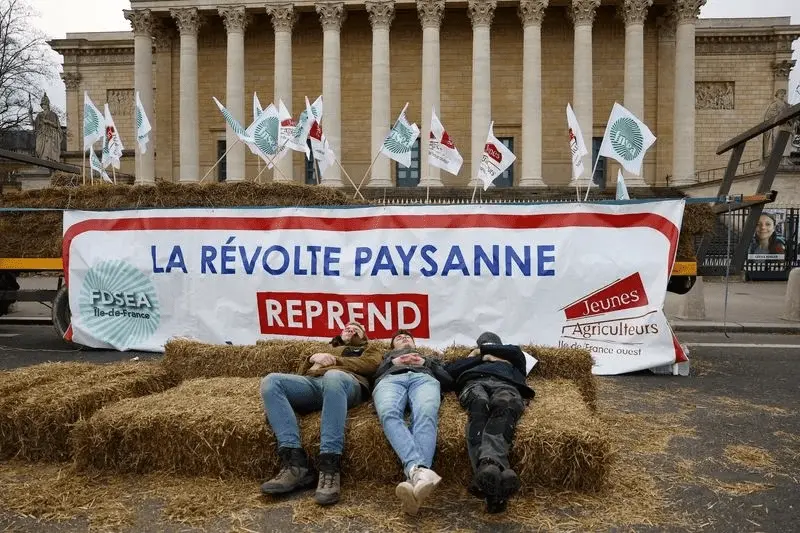
Farmer protests across Europe have intensified as the European Union moves closer to finalizing a sweeping free trade agreement with Mercosur, a South American trade bloc that includes Brazil, Argentina, Bolivia, Paraguay and Uruguay. Demonstrations in Paris, Brussels and other capitals have brought tractors into city centers and shut down major roads, highlighting growing frustration among producers who say trade and regulatory policies are putting their livelihoods at risk.
At the center of the unrest is the EU-Mercosur trade agreement, negotiated for more than 25 years and now advancing after key political backing from member states. Bill Wirtz, senior policy analyst with the Consumer Choice Center, said opposition from farmers largely stems from fears of unfair competition.
“They’re protesting because they say this is unfair competition,” Wirtz said. “The products coming out of Argentina or Brazil are not just cheaper, they’re cheaper because they’re produced under regulatory standards that are different from the European Union.”
The agreement would remove tariffs on roughly $700 billion worth of goods, spanning agriculture, manufacturing and automotive products. Supporters argue it would create one of the world’s largest free trade zones, covering nearly 780 million people and about a quarter of global GDP. Critics counter that European farmers already face higher costs tied to environmental rules, labor standards and compliance requirements.
Protests in France have become some of the most visible. Farmers have driven tractors into Paris multiple times in recent weeks, blocking roads near the Arc de Triomphe and the French parliament. Police estimated roughly 350 tractors participated in the latest demonstration. Wirtz said the scenes mirror earlier waves of agricultural unrest across the continent.
“The protests are similar to other protests we’ve seen in the past in France — spraying manure, blocking roads, setting hay bales on fire,” he said. “It’s what we already know from former protests around Europe.”
While trade has become the flashpoint, Wirtz said some demonstrations overlap with anger over regulation. He pointed to the EU’s Farm to Fork strategy, unveiled about five years ago, which proposed sweeping environmental changes.
“What that meant was cutting about half of all synthetic pesticides, reducing fertilizer use, reducing agricultural land use by 10 percent, and increasing organic agriculture to 25 percent,” Wirtz said.
Farmers warned those targets would make farming unprofitable. Paraphrasing producer comments about the issue, Wirtz said farmers convey the argument “If they make [farmers] produce under these circumstances, then [they’re] not going to be able to make a living anymore.” The strategy has since been scaled back, and the European Commission has moved toward simplifying rules and reducing paperwork. “They try to find a different way to say deregulate, but ultimately it’s deregulation,” Wirtz said, adding that farmers have notched some recent regulatory wins.
Momentum behind the trade deal accelerated after Italy confirmed its support. Italian Prime Minister Giorgia Meloni said she had no ideological objection to the agreement, but stressed safeguards for farmers were essential. Italian Foreign Minister Antonio Tajani called the move good news for Italy, saying the deal is aimed at boosting exports toward €700 billion.
European Commission President Ursula von der Leyen said the vote sends a strong signal of Europe’s economic clout and stability in what she described as an increasingly hostile global trade environment. The European Parliament is expected to vote on the agreement before it can enter into force, though ratification by individual countries could take years.
Supporters say the deal helps the EU diversify trade ties and reduce reliance on the United States and China. German Chancellor Friedrich Merz called it a milestone for European trade policy, while Brazilian President Luiz Inácio Lula da Silva described it as a historic win for multilateralism.
Opposition remains strong. France, Poland, Austria, Hungary and Ireland voted against the agreement. Irish Prime Minister Micheál Martin said his government lacks confidence that Irish farmers would not be undercut by imports. French President Emmanuel Macron said new safeguards were added, including emergency import brakes and increased inspections, but argued the economic gains do not justify the risks to EU agriculture. French officials estimate the deal would add about 0.5 percent to EU GDP by 2040.
Environmental groups have also criticized the agreement, warning it could accelerate deforestation in the Amazon and undermine climate goals. Those concerns have added to political pressure already building from farmers and opposition parties.
Beyond trade, Wirtz said global instability continues to weigh heavily on European agriculture, particularly fertilizer and feed supplies tied to the war in Ukraine and efforts to phase out imports from Russia.
“The war in Ukraine is a real problem,” Wirtz said. “A lot of the nitrogen needed to make synthetic fertilizers comes out of Russia, and a lot of the non-GMO feed for livestock comes out of Ukraine.”
He said geopolitics directly affects farmers’ ability to plan, produce and export. “Geopolitics has a real impact on how farmers are able to export in the next few months or the next few years,” Wirtz said.
Wirtz added that while trade agreements bring competition, they also bring opportunity. “Even though there is competition that comes out of these trade agreements, there’s also many opportunities,” he said, pointing to global demand for European products such as cheese and wine.
As ratification battles loom and protests continue, Wirtz urged farmers to stay engaged in the political process. “A lot of these things start with consultation and voluntary schemes, and then suddenly it’s law,” he said. “It’s not the people in office spaces who know best. It’s the people who work on the ground.”
One of the primary groups organizing and amplifying the protests in France is the Fédération Nationale des Syndicats d’Exploitants Agricoles, commonly known as FNSEA. Founded in 1946, FNSEA is France’s largest agricultural union, representing roughly 212,000 individual members through more than 21,000 local syndicates, along with regional and departmental farming federations and specialized trade bodies covering sectors such as grains, dairy and meat production.
According to the organization, FNSEA’s objectives are to support French farmers in their operations and to carry the voice of farmers into European and international policy forums. The union has long described itself as a leading force in European agriculture and has played a significant role in shaping debate around the European Union’s Common Agricultural Policy. France is the largest agricultural producer in the EU and, alongside Germany, one of the bloc’s most influential member states, giving FNSEA considerable leverage in agricultural policy discussions.
FNSEA maintains close ties with the French government and has historically influenced national farm policy. Former French agriculture minister Julien Denormandie has publicly praised a relationship of trust and reciprocity between the government and the union, underscoring FNSEA’s institutional role within France’s agricultural system.
The union has also been outspoken on pesticide policy, arguing that viable and affordable alternatives to certain crop protection tools are not yet widely available. FNSEA has criticized France for adopting stricter pesticide reduction targets than other EU member states, a disparity it says has weakened the competitiveness of French farmers. Those long-standing concerns about regulatory imbalance have carried directly into opposition to the EU-Mercosur agreement, which FNSEA leaders argue would further expose producers to imports produced under different environmental and production standards.
Other farm organizations, including Coordination Rurale, have also taken part in recent demonstrations, reflecting a broad coalition of farmer groups unified by concerns over trade, regulation and farm viability. Together, these organizations have helped sustain months of protests across France and other EU countries, ensuring agriculture remains at the center of Europe’s political debate as the EU-Mercosur agreement continues its path toward ratification.