Kansas Senator Roger Marshall is pushing for congressional action to lower fertilizer costs for American farmers, saying high input prices remain one of the biggest financial burdens in agriculture.
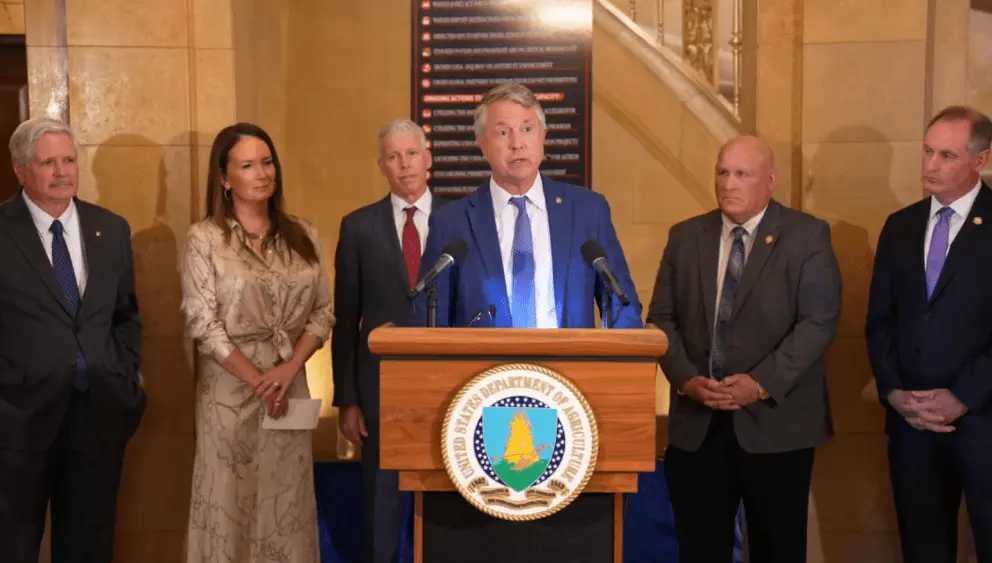
Speaking during a press conference hosted by USDA Secretary Brooke Rollins alongside U.S. Secretary of Energy Chris Wright and Environmental Protection Agency Administrator Lee Zeldin, Marshall said the United States should focus on expanding domestic fertilizer production instead of relying on imports from countries like Russia and China.
“First of all, we knew that food is medicine. Today, we learned food is energy as well. But why we like working with Brooke and with Secretary Rollins is because you take lemons and turn them into lemonade. We’re going to take this challenge right now of high fertilizer prices and ask: why aren’t we the biggest fertilizer producer in the world? Why are we buying fertilizer from Russia? Why are we buying it from China? We’re going to take lemons and turn them into lemonade. So, thank you. Thank you for doing that,” Marshall said.
Marshall emphasized fertilizer costs account for a major share of overall farm expenses, particularly for producers already facing tight margins. Fertilizer is often one of the largest input costs for corn and wheat growers, especially across the Plains where nitrogen-intensive crops dominate acreage. Even as grain prices have stabilized in some markets, elevated fertilizer costs continue to pressure farm profitability.
“The biggest challenge right now in the barnyard is input costs, okay? And fertilizers make up 40% of those input costs. So, like Secretary Rollins, like many of us, we’ve been working on this for at least five or six years. Whenever Russia invaded Ukraine, that’s when we saw fertilizer prices jump way higher than they are today, and they stayed higher for at least 18 months than they are today as well,” he said.
Global fertilizer markets experienced major disruptions following Russia’s invasion of Ukraine in 2022, as Russia and Belarus are among the world’s largest exporters of key fertilizer products. Rising natural gas prices also contributed to higher fertilizer costs because natural gas is a major component used in nitrogen fertilizer production. While prices have retreated from the record highs seen in 2022, many producers say costs remain well above historical averages.
Marshall praised what he described as an “all-of-government approach” from the Trump administration aimed at increasing domestic fertilizer production through permitting reform and investment in new facilities.
“So, certainly, there are short-term solutions, and there are long-term solutions. I love this all-of-government approach — from expediting things through the rules and permitting process, from EPA and Energy out there funding new fertilizer plants as well. So, lots of good things are happening, but there are things Congress needs to do, too,” Marshall said.
The senator also pointed to broader rural policy initiatives backed by President Donald Trump, including support for crop insurance and rural healthcare funding.
“All right, it’s time to stop relying only on the Trump Administration, who, by the way, I think has done more for rural America than any administration has ever done, including adding $65 billion to the crop insurance programs, a $50 billion Rural Health Transformation Fund, just for starters as well. So, we’re locked in on this — bringing down the cost of fertilizers,” he said.
Marshall highlighted several fertilizer-related bills he wants Congress to advance, including the Fertilizer Transparency Act, the Fertilizer Research Act of 2025, the Homegrown Fertilizer Act, the Plant Biostimulant Act, and the Fertilizer Sustain Act. The measures are designed to improve market transparency, support domestic fertilizer manufacturing, encourage research and innovation, and streamline approval processes for alternative crop-input technologies.
He also renewed calls to remove countervailing duties on phosphate imports from Morocco. The tariffs were imposed in 2021 following a trade case involving domestic fertilizer producer The Mosaic Company. Supporters of removing the duties argue the tariffs have limited supply options and increased fertilizer costs for farmers, while domestic manufacturers maintain the measures are necessary to protect U.S. producers from unfairly subsidized imports.
Kansas farmers remain especially vulnerable to fertilizer volatility because the state is one of the nation’s leading wheat producers, and many producers throughout the region rely heavily on commercial fertilizer applications to maintain yields. Supply chain disruptions following the Ukraine war created additional challenges for farm cooperatives and rural retailers across the Midwest and Plains.
New fertilizer production projects have also been proposed across parts of the Midwest and Gulf Coast in recent years, though industry leaders frequently cite permitting timelines, infrastructure needs, and energy costs as barriers to expanding domestic manufacturing capacity.
Some analysts note that increasing U.S. fertilizer production may help improve supply stability but may not completely shield farmers from global price swings because fertilizer markets remain highly interconnected worldwide. Environmental groups have also raised concerns about emissions tied to fertilizer manufacturing and nutrient runoff issues associated with fertilizer use.
“So, again, the White House is doing its part. Congress needs to step up and act at Trump speed and try to help solve this riddle for American farmers. Thank you,” Marshall said.
Congressional debate over fertilizer policy is expected to intensify as lawmakers continue discussions surrounding farm policy, domestic manufacturing, and agricultural input costs ahead of future farm bill negotiations.