DMC was designed to provide a financial backstop when the margin between milk revenue and feed costs compresses. Since its current form took effect in 2019, the program has delivered more than $2.7 billion in net support, including over $1 billion in payments in both 2021 and 2023. But DMC only measures what its formula captures: a national income-over-feed-cost margin. Labor, fuel, veterinary expenses, capital recovery and other overhead costs, which have risen roughly 21% since 2021, fall entirely outside the calculation. When feed costs ease but overhead remains elevated, the calculated margin can stay above trigger levels even as actual farm profitability deteriorates.
That structural gap shapes how farmers use the program. This Market Intel examines what lifting that ceiling in 50-cent option increments up to $12 would have meant for farmers over the past six years, and considers a parallel opportunity with DRP, where a statutory 95% coverage ceiling similarly constrains how much protection farmers can access.
How DMC is Structured
DMC pays farmers the difference between their selected coverage level and the national margin when that margin falls short. The program has two tiers of coverage, each serving a different portion of a farm’s production history.
Tier 1 covers the first 5 million pounds of a farm’s production history (raised to 6 million pounds under the One Big Beautiful Bill Act beginning in 2026). Coverage is available in 50-cent increments from $4 to $9.50, with premiums that rise with the coverage level selected, ranging from effectively zero at the catastrophic $4 level up to 15 cents per hundredweight at $9.50. Tier 1 is designed as the affordable foundation of the program, with premiums low enough to make buy-up coverage accessible for most operations.
Tier 2 covers production above the Tier 1 threshold, with coverage available between $4 and $8. Tier 2 premiums increase more steeply with coverage level, reaching as high as $1.813 per hundredweight at $8, which makes buying up to higher Tier 2 coverage levels cost-prohibitive for many larger operations. In practice, most Tier 2 production is enrolled at or near the catastrophic $4 level.
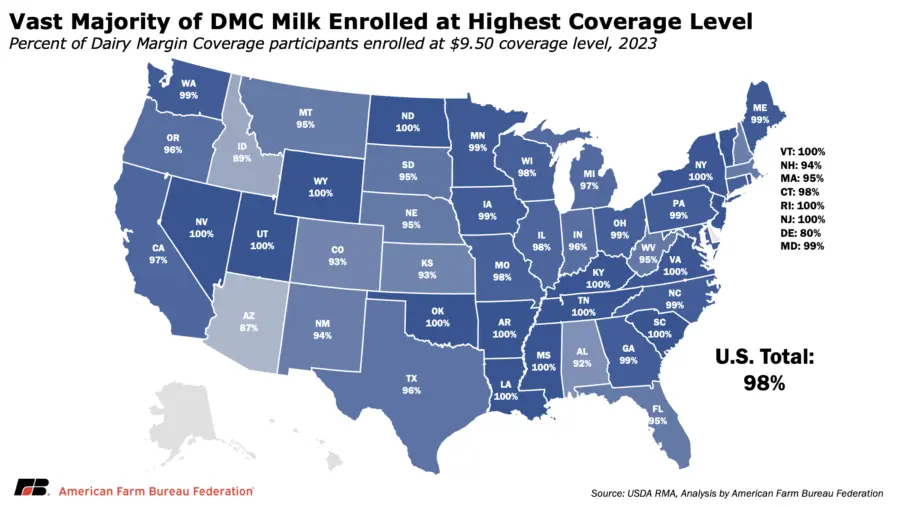
In 2023, 98% of all Tier 1 enrolled milk was at the $9.50 maximum coverage level. Most states were at 95% or higher; with several at 100% and only two below 90% (Arizona and Delaware). A distribution this concentrated at a single level is consistent with farmers hitting a ceiling rather than naturally converging on a preferred coverage amount. The data does not prove unmet demand but strongly signals it.
Read more from AFBF here: https://www.fb.org/market-intel/rethinking-coverage-limits-in-dairy-risk-programs