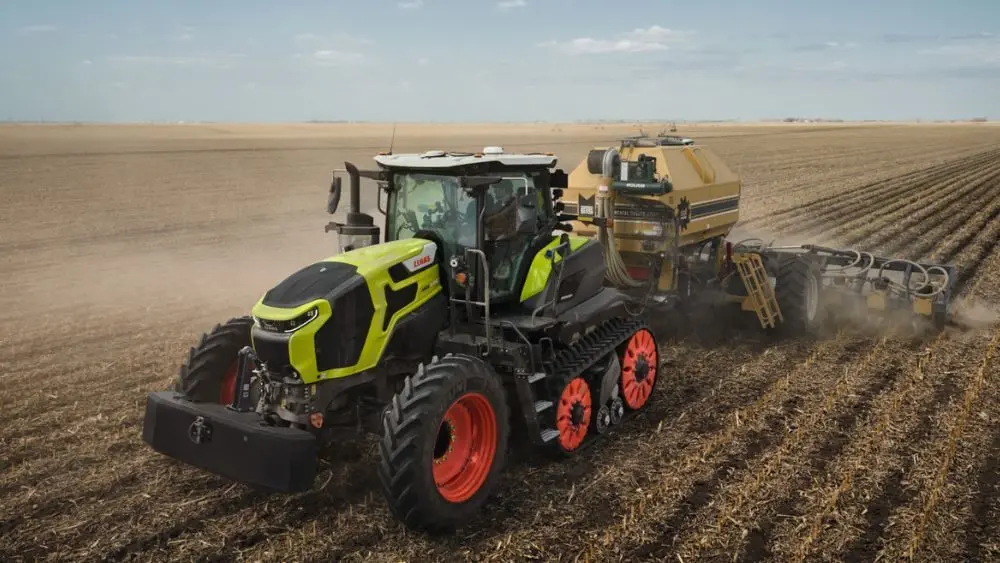
(BOONE, IA) — Three years into what CLAAS calls a methodical product launch strategy, the company used day one of the 2026 Farm Progress Show to make its case for a bigger role in the North American market, backed by new tractors, an updated forage harvester lineup and continued investment in its U.S. operations.
A Deliberate, Multi-Year Rollout
Eric Raby, CLAAS senior vice president for Region Americas, said the timing of this year’s tractor launch is no accident.
“About three years ago, we started on a very methodical product launch schedule,” Raby said. “We launched the XERION tractor first, the four-wheel drive. Last year, we launched the new forage harvester, and this year, launching an entirely new range of standard tractors.”
All CLAAS combines sold in North America are built in Omaha, Nebraska, where the company recently opened a new Customer Experience Center and will open a new Research and Development Center next month. Raby said CLAAS made a deliberate decision back in 2019 to consolidate around one brand, one color and one distribution network in North America, a process that has included changing and expanding dealer partners and opening some CLAAS-owned locations.
“We want customers to know that when they do invest in a CLAAS piece of equipment, that’s when the relationship starts,” Raby said. “That’s the most important part.”
He said parts and service back that relationship up. “We really look diligently at how long does it take us to get a part in the hand of a customer once they request it. And we’re measuring that not in days, but in minutes, because that’s the most important part.”
Investing Through a Down Cycle
When asked how the current ag economy affects CLAAS’s approach to innovation, Raby said spending has not slowed down.
“It doesn’t stop, believe it or not,” he said. “We look at what we’re spending as a percentage of our total turnover per year, and that doesn’t change. In fact, it actually increases, because we know that the agricultural market is cyclical. Always has been, always will be.”
Looking ahead five to ten years, Raby pointed to autonomy and site-specific farming down to the row level as major forces reshaping the industry. He described CLAAS’s approach to technology in two categories.
“One is covert and the other is overt,” Raby said. “The overt is the kind that you see, it’s out there, it’s the user interface. The covert part is even more important, because that’s the technology, like our combines, for instance, that changes settings on the fly automatically, and the customer doesn’t even have to do anything.”
He closed with an open invitation to producers still getting to know the brand. “We may not be a company that they’ve heard of necessarily in the past, but I would invite them to come and talk to us. If you’re ever in Omaha, you can stop in, and we’ll show you the world’s best combine, and give you the worst cup of coffee in Omaha all at the same time.”
Four Pillars Behind the New Tractor Lineup
CLAAS tractor product specialist Tanner Whipps said the new ARION 6, AXION 8 and AXION 9 CMATIC tractors, spanning roughly 165 to 653 horsepower once the XERION 12 series is included, represent the company’s largest tractor presence yet at the show.
“We are super excited here at the 2026 Farm Progress Show to do the official public launch of the new generation CLAAS tractors,” Whipps said. “I think this is the most tractors we’ve ever had on the CLAAS lot and here at Farm Progress.”
Whipps said the lineup was shaped by conversations with farmers in North America and around the world about what they needed most. “I think what we stepped away with was four key pillars: efficient performance, uptime reliability, operator comfort, and assistance and automation,” he said. “I think with these new generation tractors, we’ve really hit on these. This is the most complete tractor lineup I think CLAAS has ever brought to the market.”
When it comes to efficiency, Whipps pointed to AUTO DROOP, which continuously maintains optimal engine droop, and AUTO LOAD ANTICIPATION, which learns implement loads throughout the day and adjusts the machine automatically. CVT is now CLAAS’s only transmission offering in North America, a decision Whipps said was driven partly by a shrinking pool of skilled labor.
“When we look at the CVT transmission, it’s super simple. It’s super user-friendly to teach someone to operate it,” Whipps said. “I actually, yesterday, while you were doing your ride and drive, I taught a 10-year-old and a 12-year-old to drive a tractor. They picked it up like it was nothing.”
Inside the cab, he said, the new C-Motion handle lets an operator run nearly the entire machine with a three-finger reach. “Especially with the new generation Axions, when you get in the cab, it’s one of the nicest fit and finishes you will find on the market these days,” Whipps said.
Forage Harvester Gets New Headers and AI-Driven Quality Checks
On the forage side, CLAAS forage harvester specialist Alan Osterhaus said the Jaguar 1000 series, launched globally and in North America last year, is making its first appearance at the Farm Progress Show this year.
“This is kind of the first time we’ve had the Jaguar 1000 series here at Farm Progress Show,” Osterhaus said. “It’s our largest forage harvester to date, widest crop flow componentry, but also more power than we ever offered before.”
Two new headers join the lineup. “That’s the ORBIS 12000 on the front of it, our new 40-foot header for corn silage,” Osterhaus said, pointing to the machine on the show stand. He said CLAAS is also introducing the DirectDisc 8400, a 28-foot header for whole-crop silage that he called “the largest DirectDisc header on the market available.”
Osterhaus said a wider header lets operators keep the machine full and crop flow consistent, which matters more for crop quality than simply running faster. “At the end of the day, you want to try to keep the machine full. That’s where you’re going to get your best crop quality from,” he said.
CLAAS is pairing the new headers with AI-powered crop quality analysis inside CLAAS Connect. “We’re actually using AI to identify the kernels that are making it through the machine,” Osterhaus said. “The idea, obviously, is to make sure that we’re splitting all those kernels.”
A new CEMOS auto knife conditioning feature is designed to help less experienced operators, he said. “Instead of us guessing how often we need to sharpen our knives, we can actually visually see, based on the readings from the machine, okay, maybe this end of the field had a little bit more sand in it. Maybe we need to sharpen a little bit more often here versus the other end of the field.”
Learn more online at claas.com or visit your local CLAAS dealer. Watch all three interviews below from the Tuesday, September 2nd, 2026 episode of Market Talk during the Farm Progress Show below: