Rising input costs tied to the conflict in the Middle East are adding strain to an already challenging farm economy. To better understand how global fertilizer market disruptions are affecting producers during spring planting, the American Farm Bureau Federation conducted a Fertilizer Availability Survey of farmers and ranchers across the country. More than 5,700 farmers responded to the survey, which was conducted April 3 through April 11.
Regional Differences Reflect Crop Mix and Supply Exposure
Survey responses show the closure of the Strait of Hormuz is affecting regions across the United States differently because crop production systems and fertilizer needs vary.
Midwestern producers – often relying on a corn and soybean rotation – reported higher pre-booking rates, with 67% securing fertilizer earlier in the season. Given these crop rotations, pre-booking is more common in the Midwest, where fertilizer needs are typically larger and purchasing decisions are often made well ahead of planting. As a result, a larger share of Midwestern farmers reported being able to secure the inputs they need before recent price increases. Even with higher pre-booking rates, nearly one in three Midwestern farmers still report entering the season without securing all of their fertilizer needs.
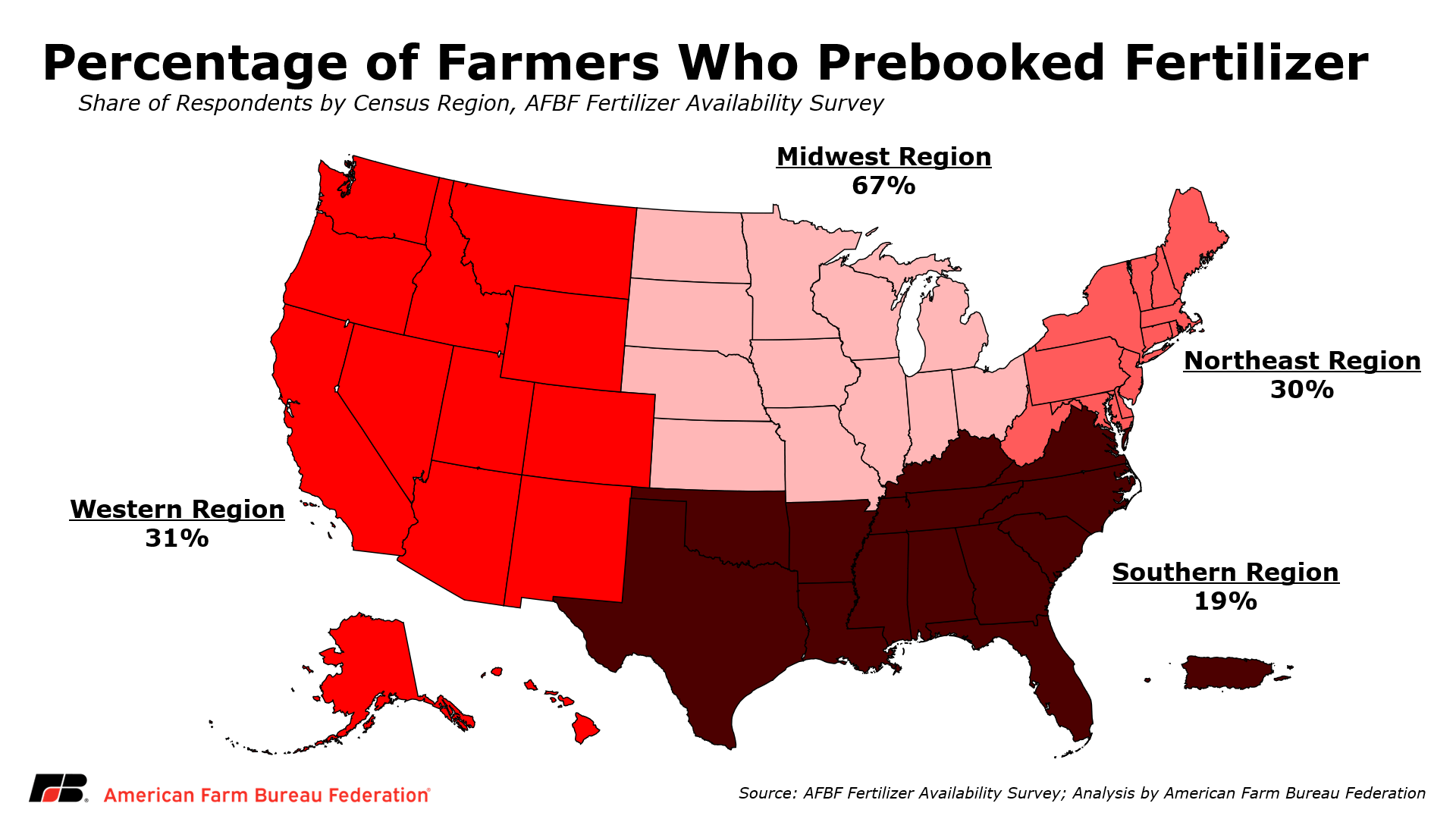
In contrast, producers in other regions are more likely to purchase fertilizer closer to application, increasing exposure to in-season price volatility during periods of market disruption. Nineteen percent of southern farmers pre-booked fertilizer this crop year. Southern producers often grow crops such as cotton, rice, soybeans, corn and peanuts that rely heavily on applied nutrients and can be particularly sensitive to changes in fertilizer costs. Pre-booking rates are similarly limited in other regions, with just 30% of farmers in the Northeast and 31% in the West securing fertilizer ahead of the season.
Smaller farms reported substantially lower fertilizer pre-booking rates than larger operations across every region, suggesting greater exposure to recent price volatility during the spring purchasing window. In the Midwest, 49% of farms with 1–499 acres pre-booked fertilizer, compared to 77% of farms with 500–2,499 acres and 76% of farms with 2,500+ acres. The gap was even more pronounced in the Northeast, where only 24% of the smallest farms pre-booked fertilizer, compared to 35% of mid-sized farms and 67% of the largest operations. Similar patterns appeared in the South (16% for 1–499 acres vs. 28% for 2,500+ acres) and West (25% vs. 54%). Because smaller farms are less likely to secure fertilizer ahead of the season, they are more exposed to in-season price increases, which can make it harder to afford full application rates and increase the risk of reduced yields and tighter margins in 2026.
Read more from Farm Bureau here: https://www.fb.org/market-intel/farm-bureau-survey-reveals-real-impact-of-fertilizer-availability-and-price