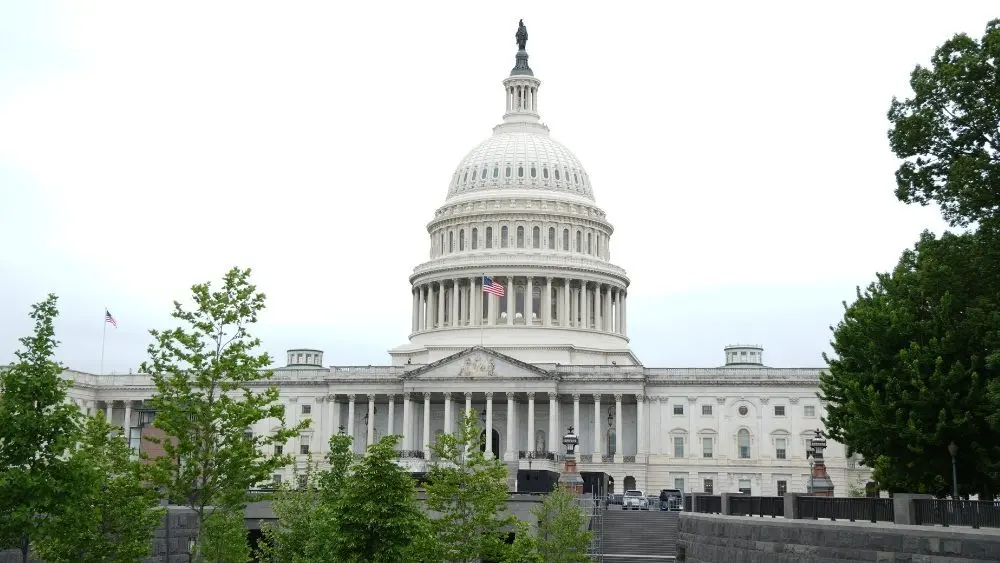
JAMESTOWN, ND — As the U.S. House of Representatives worked through the night on farm bill amendments ahead of Thursday’s historic vote, North Dakota Farmers Union President Matt Perdue was watching closely from back home — and he wasn’t hiding his frustration.
Speaking on Thursday’s Agriculture of America shortly before the House passed the Farm, Food, and National Security Act of 2026 by a 224-200 vote, Perdue reserved his sharpest criticism not for the farm bill itself, but for the last-minute decision to decouple year-round E15 legislation from the package — punting a standalone vote to after Congress returns from recess in May.
“Year-round E15 — it’s been at the one yard line for two years,” Perdue said. “I’m really disappointed that Congress has again missed an opportunity to get that done, to provide that strong, stable demand for commodities grown here in the United States.”
Perdue described the week on Capitol Hill as a classic case of legislative overreach, with House Speaker Mike Johnson attempting to move four major pieces of legislation simultaneously — the FISA bill, the budget resolution, the farm bill and year-round E15 — only to watch the strategy unravel.
“I think Speaker Johnson thought he would play some three-dimensional chess with this and ultimately found out he couldn’t keep it all together,” Perdue said. “Yesterday we thought the farm bill was out of the equation. Then by the time we got to last evening, it turns out that E15 is really what they punted on.”
Despite the disappointment on E15, Perdue welcomed the farm bill’s advancement to the Senate, while making clear he sees significant room for improvement. He pointed to rising input costs, corporate consolidation in the fertilizer market, and broader geopolitical volatility — including tariff disputes and trade tensions — as issues the Senate version needs to address more aggressively.
“We continue to face challenges with rising input costs,” he said. “We need to enforce our antitrust laws, strengthen those laws, and make sure that everybody is playing by the rules.”
Perdue also offered a pointed critique of the farm safety net itself, suggesting that even with recent improvements made through last year’s reconciliation package, the current system isn’t built for the realities facing today’s producers.
“I think the sad reality is there’s probably additional assistance needed,” he said. “But when we’re providing all of this additional assistance on top of improvements we made in the reconciliation package, I think it demonstrates that our farm safety net really isn’t designed for the modern realities that we face in production agriculture.”
On the administration’s recent push to onshore domestic fertilizer production — the subject of a USDA announcement earlier this week — Perdue was measured. He welcomed the attention to the issue but made clear that talk alone won’t move the needle for farmers staring down sky-high input costs heading into spring planting.
“Those fertilizer costs are not going to go down because we talked about ways that we want to solve the fertilizer problem,” he said. “They’re going to go down when we really act on some of those ideas.”
With North Dakota just beginning to get small grains in the ground, Perdue said the stakes of Congressional inaction are as tangible as they get right now.
“We’re in the middle of spring planting. If we decide that it’s too hard or too confusing or too complicated to plant this spring, guess what? There’s no harvest in the fall. There are real consequences to the decisions we make, and we need Congress to step up and support us.”
The farm bill now heads to the Senate, which has yet to release its own bill text or schedule a committee markup. A standalone E15 vote in the House is expected within the next two weeks.
***AUDIO*** Hear Purdue’s full interview from Thursday’s episode of Agriculture of America below: